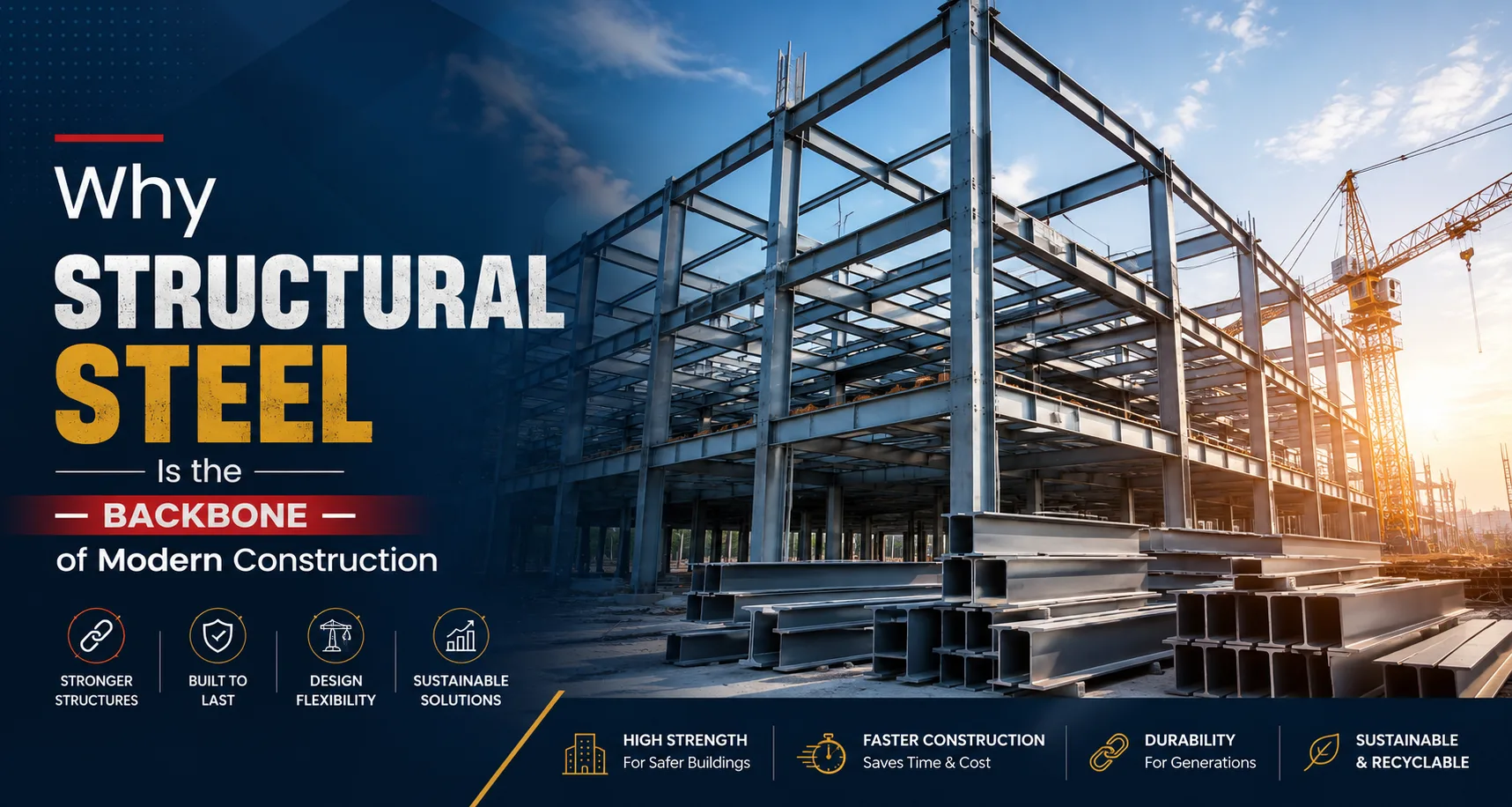
A common sight when imagining any urban city landscape is the big commercial buildings in which a steel framework forms the skeleton of the building. Everything else, the composite concrete and roofing sheets, is filled around it. So what is the big deal about steel structures that makes it the backbone of modern construction? For every industrial and commercial-scale construction project, there are structural steel fabricators manufacturers who turn the raw materials into the exact beams and columns specific to the project. In this blog, we are going to explore the various aspects of structural steel and unfold its significant role.
Quick Facts At A Glance
- Steel’s strength-to-weight ratio is 4-6 times higher than concrete for the same load-bearing capacity.
- The dead weight of the whole building is reduced by 30 to 50 %, putting less load on the foundation.
- Since the components arrive prefabricated, the time taken in erection and assembly is 25-30 % less than concrete structures.
- Most of the steel components can be recycled without any loss in performance.
Reasons Why Steel is Preferred in Construction
- Trusted for Longevity: Every component of any building has a threshold of tolerating the forces. Buildings that suddenly collapse under the exceeding forces are not ideal. Steel structures show signs of deformation much before collapsing, giving ample time to repair, maintain, or evacuate the space. This quality makes it a highly dependable choice.
- Top Choice for Sustainable Building: Sustainability is the trend that will remain for decades, and steel is the best choice because it can be reused and recycled.
- Speed and Precision: Steel is easy to machine. When combined with modern technology, high precision is achieved in each project. From the columns to roofing sheets, from trusses to beams, every inch is built to precision, and that too at remarkably quick speed.
- Architectural Flexibility: To understand the dominance of steel, let’s see how it compares to other construction materials- concrete and timber. Concrete structures are excellent at exhibiting tensile strength, but weaker in compression, so they need steel bars to hold themselves together. Timber is light in weight and therefore the dead weight is low, but it cannot be used for multiple-storey buildings. It can be shaped into grids, trusses, hollow sections, circular sections, etc.
Conclusion
Beyond the civil engineering calculations, there are many benefits for businesses when they choose steel structures. The structures can be built around an industrial zone, giving a lot of income opportunities to the technicians, employees, non technicals labours and contractors. With strength, precision, adaptability, and efficiency, the steel structural steel has become an integral part of modern buildings.
VGS Solar and Building System Pvt Ltd has been a frontrunner in steel structure manufacturing and supply to some of the reputed businesses. We have successfully finished construction of industrial sheds and infrastructure projects.
Frequently Asked Questions
A fabricated steel structure is cut, shaped, drilled, bolted, welded, and finished from structural steel sections and sheets. These form the columns, beams, rafters, trusses, and other parts of the steel buildings.
The strength-to-weight ratio, tensile strength, and compressive strength of steel make it the most suitable material for modern construction.
Steel structures form the skeleton of factory sheds, warehouses, railway projects, bridges, commercial buildings, aircraft hangars, etc.
Based on years of experience, project portfolio, and success rate, VGS Solar & Building Systems is the top-rated steel structure manufacturer in India.
Combining the cost of raw material sourcing, fabrication, transportation, and labour, the cost of a steel structure in India is somewhere between ₹ 90 and ₹ 145 per kg in 2026.